Every once in a while, a story comes along that starts with a simple message… and turns into something pretty incredible.
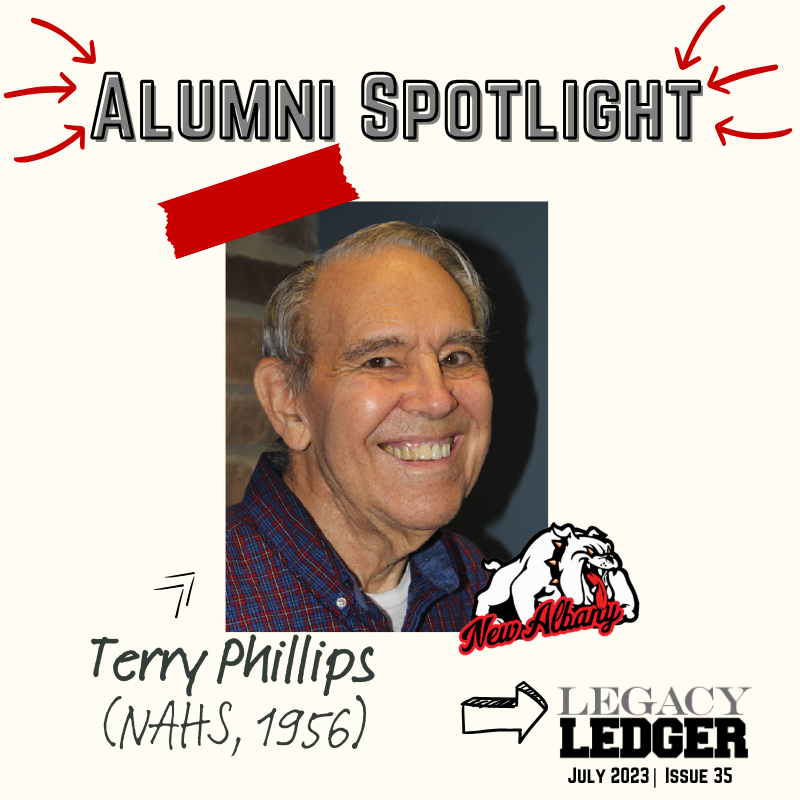
We’re taking it back to July 2023 to revisit the story of Terry Phillips (NAHS ’56). From running the WNAS transmitter as a student to working alongside pioneers in satellite mapping and even presenting to Wernher von Braun, his journey is one you don’t expect… but won’t forget.
Article originally appeared in the July 2023 Legacy Ledger (Issue 35).

-Rex Bickers (FCHS ‘70)
Terry Phillips (NAHS ’56)
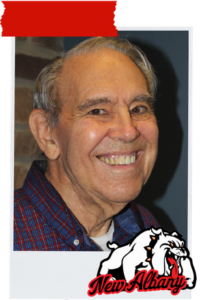
The origin of Terry Phillips’ story is yet another first-ever occurrence for this newsletter. This month’s profile began last fall when Terry sent us a message himself. He was motivated by our November 2022 issue, featuring Stanley Brown, NAHS ’62. In the introduction to Stanley’s profile, we included a photo from the early years of WNAS.
It brought back special memories to Terry. In that “Veterans’ Day” issue, our goal was to highlight the student WNAS experiences in the 1950s, as well as the newly offered ”shop” classes, called electronics. Both things were valuable for eighteen-year-olds joining the Navy. Terry graduated six years before Stanley, so some things were clearly different, but there were some similarities. The electronics classes didn’t exist yet, but Terry did earn a third-class Radio Telephone Operator License. In his senior year, he operated the WNAS radio transmitter. Like Stanley, he joined the Navy straight out of high school. He served in active duty from 1956 to 1959, followed by three years at Purdue in the reserves. By 1964, he had earned a B.S. degree in Electrical Engineering (or “E.E.”).
His Purdue years began a brush with greatness that lasted three decades. He began work on a master’s degree in E.E., awarded in 1966. It meant joining professors who essentially invented satellite mapping. He became part of the team that founded Purdue’s “Laboratory for Agricultural Remote Sensing” (LARS), supported by grants from NASA and the USDA Agricultural Research Service. Its work was based on data from the first U.S. (1960) weather satellite. LARS was later renamed the Laboratory for Applications in Remote Sensing, reflecting broader objectives. Purdue went on to lead a collaborative effort eventually known as Landsat, combining the necessary signal acquisition, computer programming and graphic displays.
Terry recalls a crucial LARS event at the Marshall Space Flight Center (also called “NASA Huntsville”). The LARS director was supposed to give an important talk. Conflicts led him to send Terry instead. A buzz went around. Many Marshall staff didn’t fully grasp what Purdue was doing. Terry was very surprised when they delayed his presentation for two whole hours… so that “a certain VIP” could hear it. That person turned out to be Wernher von Braun! He wanted to learn just what remote sensing could do.
Terry had other vital roles at LARS. He connected the first video (television) monitor to a computer for use in Landsat data analysis. He also helped design a computer network to teach people how to use Landsat output.
By 1988, he transitioned to a broader responsibility, overseeing Purdue students’ uses of personal computers, campus-wide. Over the next decade, he worked in the Continuing Education business office, and he completed the requirements to become a CPA. In 2000, Terry left Purdue to work as a Personal Financial Advisor until he retired in 2007. Terry and his pharmacist/wife Lynne (also a Purdue grad) have just recently celebrated 60 years of marriage. The couple raised two children and currently have three grandchildren, ranging in ages from 16 to 23.
Read the entire July 2023 Legacy Ledger (Issue 35) edition.