


Matt Uhl (FCHS ’97)

Matt’s career story has been fairly similar to that of other FC grads his age. With an IU degree in sports marketing, he began on one path and he was successful enough to try a second one: finance and accounting. He started with IU Sports Properties, then gained the experience needed in finance and bank auditing to “come home” and extend his banking career. His first job back in this area was as a regional manager for WesBanco; he also pursued an MBA from the University of Southern Indiana, completing that in 2019. Since 2020, he has been a compliance manager in consumer lending for Farm Credit Mid America. But it’s not his “day job” achievements that are the real reasons for introducing him here. In less than ten years, Matt has garnered a lot of attention and admiration for his work in local history.
He’s figured out one thing for sure: there’s a learning curve… doing what it takes to attain an Indiana State Historical Marker. Take the case of Norman Colman, a cabinet member in the White House under Grover Cleveland, twenty years after the Civil War. Colman was the first (and so far, the only) person with “local roots” to ever achieve that. Decades earlier, he had been hired in Greenville, the first principal at “the Floyd County Seminary” at age 23.
As a boy, Colman attended a “public seminary”, a sort of “college”, quite common in the early 1800s. They preceded public high schools. At age 19, he moved south from New York to Kentucky, hoping to teach. By 1849, having earned a law degree in Louisville, he was still seeking a teaching job. Greenville recruited him and opened their school in 1850. Just two years later, Indiana passed laws that created public high schools (New Albany was the first, in 1853). The seminaries were “urged” to close with few other choices.
Colman went west and took up journalism in Missouri, focused on rural America. It set him up to become State Agriculture Commissioner, and then on to Washington. He was named Secretary of the Department of Agriculture in 1885. The Indiana Historical Bureau ruled against a state historic marker. His cabinet position had almost no impact here, decades after he left Indiana. Still, his local relevance as a pioneer educator was unquestioned. That’s the reason that there is now a Town of Greenville historic marker honoring Norman Colman. His story is still a mission accomplished, in awareness and community pride.
In some cases, getting greater local recognition was easier. Here are two examples: Greenville native John B. Ford, the first person to create a successful company producing plate glass… or Hall of Famer (and Supreme Court Justice) Sherman Minton (NAHS class of 1910). They’re easily found in history books… yet their significance had never been commemorated in their own “home towns”. Matt is quick to say… he hasn’t done these things alone. He serves as chair of the Greenville Historic Commission and his main focus is there. But he also chronicles life from the past 250 years… hidden among the other small town communities of Floyd County.
Matt can name lots of people, locations and events with tales worth re-telling. Here’s one of those people: MLB (Detroit Tigers) pitcher Roscoe Miller, from Greenville, who set an American League record in 1911 for games completed (35) as a rookie. It still stands today! There are little known locations, like Freedomland, the final resting places of local black residents for over a century. It’s been the center of many years of work by fellow FC grad Tim Allen ’83 (recipient of the 2021 Distinguished Highlander Award). Add to these events, like the construction of the Duncan (or Edwardsville) tunnel. Matt was certainly not the first, by any account, to circulate these stories. But he has helped to drive their overall awareness and much, much more.
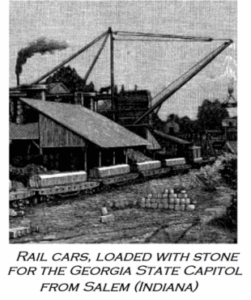 “The tunnel that changed the Midwest”, which Matt wrote in 2019, includes this 1887 photo and a useful review of the evolving early rail lines in our state. Rail was vital to growing commerce, headed north and south… from many parts of Indiana. The Duncan Tunnel (longest in Indiana at 4285 ft), greatly increased the practicality of shipping coal, limestone and more, when it opened in 1881.
They’re almost innumerable…these insights that Matt has shared… and that he’ll continue to share with many FC alumni families. Before the year is over, you’ll likely hear about more projects and his plans to bring them into the public eye.
When he’s not busy helping to nurture all the things that make Greenville a great place to live, you might find Matt, his wife Erin and their two children showing rabbits, out in the community, volunteering for 4H events or at Northside Christian Church.
Read the entire February 2023 Legacy Ledger (Issue 30).